
The Only Property Strategy Generating
£4,000+ Monthly Income
The Councils are actively funding
Join a select group of serious investors for an intensive all-day training where you'll learn the exact framework local authorities use to allocate hundreds of millions in accommodation funding, and how to access it before this window closes!
SATURDAY 29TH AUGUST
SATURDAY 29TH AUGUST
9:00 A.M. TO 5:30 P.M.
9:00 A.M. TO 5:30 P.M.
IN PERSON WORKSHOP
IN PERSON WORKSHOP
Where the Extra Monthly Profit Actually Comes From
Most property investors think they know the market. They understand BTLs. They've looked at HMOs.
They've calculated yields on Rightmove listings.
But there's an entire funding stream that operates completely outside the standard property market and it's being deployed right now across Uk local councils. The Department of Work and Pensions doesn't buy property on the open market.
They don't negotiate with landlords on Rightmove. Instead, they allocate hundreds of millions annually to local authorities, who then distribute that funding to Housing Associations and approved operators to provide accommodation for people in crisis.
And because this money has to be spent quickly, and because the priority is solving a social problem (not getting the cheapest rate), the funding rates are significantly higher than standard market rents.
This is where the £4,000+ monthly income comes from. Not from sophisticated structuring. Not from creative finance. From understanding how government funding allocates differently than how private tenants think about rent.
While Landlords Face New Restrictions,
This Model Bypasses Them
Here's what most landlords don't realise about the Renters' Rights Bill that has just come into play in May.
The new legislation has changed everything about how traditional buy-to-lets operate.
Section 21 evictions? Gone.
Rent increase restrictions? Coming.
New regulations around property standards? Tightening.
And even if you're a good landlord running compliant properties, the new rules make it harder to operate profitably.
Your costs are going up. Your flexibility is going down. And many landlords are already planning their exit from the sector.
But here's what makes supported exempt accommodation different.
It operates under a completely separate regulatory framework.
Because you're providing housing for vulnerable people under local authority arrangements, you're exempt from many of the restrictions that are crippling traditional landlords.
You're not dealing with Section 21 issues.
You're not navigating the new rent control mechanisms.
You're not subject to the same tenant dispute processes.
The council is your partner in this. They need the accommodation. They fund it properly. And they work with operators who deliver quality housing.
This is why investors who understand supported exempt accommodation are moving into this model while traditional landlords are moving out.
They're working inside a framework that prioritises providing needed housing over the bureaucratic restrictions hitting the private rental sector.
Why This Window Is Closing Fast
Over the past 18 months, I've watched councils tighten their criteria for who they work with. They've introduced new standards. They're actively separating operators who are delivering properly from those who cut corners.
Right now, the system is accessible. But the infrastructure is being professionalized. And in 6-12 months, that accessibility will likely be gone. The operators who are positioned correctly now will have locked in relationships. The ones trying to figure it out later will find doors closed.
This isn't about creating urgency for urgency's sake. This is about watching regulatory structures evolve in real time and understanding that the window for entry isn't infinite.
That's why we're running this workshop now. Not in six months. Not after you've spent 20 hours on YouTube videos and council calls. Now.
Why UK Councils Are Spending
Hundreds of Millions on This?
I get asked regularly whether this model works across the country.
And the answer is: Yes, absolutely.
Councils nationwide have established pathways for exempt accommodation.
The funding is there.
The demand is immediate.
More importantly, I've spent years building relationships with the operators who understand how to deliver this properly and are already working with local authorities.
Which means there's a proven structure in place.
You're not pioneering a new model in an untested area.
You're stepping into something that's already working, with partners who've done this repeatedly across multiple regions.
But here's what's changing.
Local authorities are actively tightening their criteria for who they work with.
I've watched them introduce new standards.
I've seen them separate operators who are doing this properly from those who aren't.
And if you're not positioned correctly before these changes take full effect, you'll either miss the opportunity entirely, or you'll get caught in the shake-out with the operators who didn't build this the right way.
This isn't manufactured urgency.
I'm watching this regulatory evolution happen in real time.
The window for entry is open right now. But I can see it narrowing.
And honestly?
Some people in the housing sector have told me I shouldn't be sharing this information publicly.
Understanding the Path to These Higher Returns
I'm walking through exactly how this model operates, what makes it work, why the profit margins are what they are, and how you can access it through our proven partnership structure - even if you've never done a supported accommodation deal before.
More importantly, I'm showing you the parts most investors get wrong when they try to enter this space without understanding how the council system actually works.
Why We Are Running This Workshop...
We could run this as a free webinar. Hand-hold people through the basics.
Throw up a registration link. Let 500 people join, half of whom don't show up, and spend the whole time managing questions from people who aren't serious.
Instead, we're charging £499 for a reason.
This filters for serious investors. When you've paid to be there, you show up. You engage. You take notes. You actually implement what you learn.
This limits the group. We're capping attendance at 28 people. That means real Q&A.; That means you can ask Henna and Saj specific questions about your situation. That means the networking isn't you shouting into a void—it's actually building relationships with vetted investors.
This covers the operational cost. Running a full-day event with operators sharing real, actionable information costs money. We're not subsidizing this with upsells or hidden agendas. The ticket covers the training. Full stop.
This means you're actually invested. People who pay are 10x more likely to implement. They've already made a financial commitment. They're not browsing. They're not "maybe interested." The £499 is a filter for the right people.
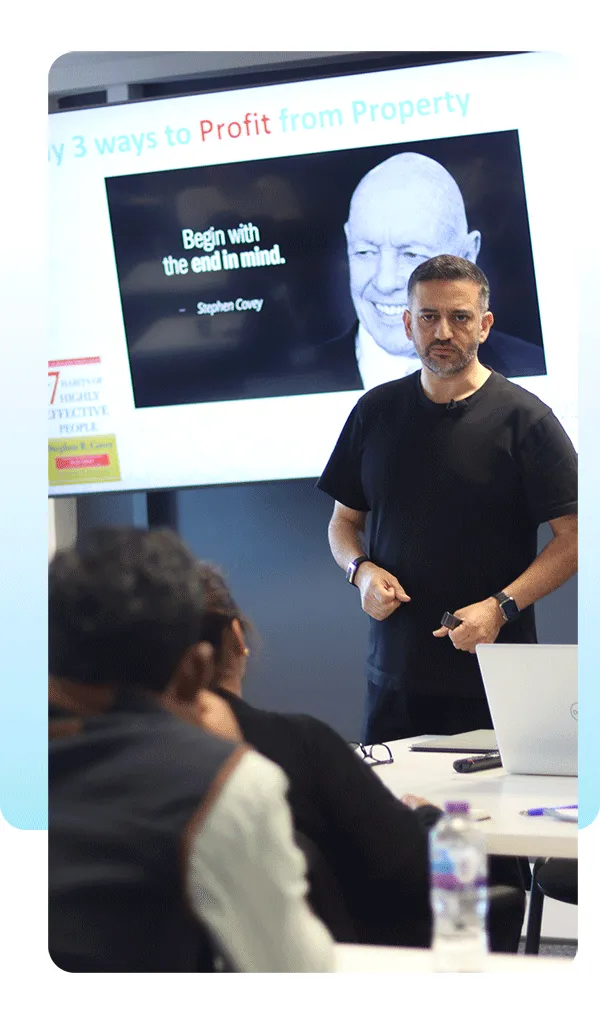
In This Workshop, You’ll Discover:
In This Workshop, You’ll Discover:
The difference between supported exempt accommodation that works and the cowboys who are about to get swept out
Because councils are actively separating operators right now, and if you don't understand the criteria, you'll be on the wrong side of the line
Why councils across the UK are spending hundreds of millions annually
on this model.
And what that funding structure means for the returns you can realistically generate from a standard 3-bed property and even from HMO’s
How the profit model actually breaks down
From acquisition to setup to monthly returns, so you understand exactly where the up to £4,000 monthly income is coming from and why it's not speculative
Why this isn't something you can just "figure out" by Googling or calling the council
The relationships, the structure, and the operational requirements that make this work are not publicly documented in a way that's actionable
How this model bypasses the new Tenants' Rights Act restrictions
And why you're exempt from the regulations that are making traditional buy-to-lets harder to operate profitably
What the regulatory tightening means
And specifically how to position yourself now so you're operating on the right side of the new criteria when they come into effect
The partnership structure that handles the operational complexity
Because while the returns are strong, the management requirements for supported exempt accommodation are different from standard BTLs or HMOs, and most investors don't want to (or shouldn't) handle that themselves
Why speed matters right now
Not in a manufactured "limited seats" way, but because the regulatory window is actively closing and councils are tightening their approved operator lists as we speak
The Workshop Details
29th August, 2026
9:00 a.m. to 5:30 p.m.
499
The ticket includes:
Full-day intensive training
Access to the council funding framework breakdown
Networking with vetted, serious investors
Direct Q&A
Refreshments & Lunch

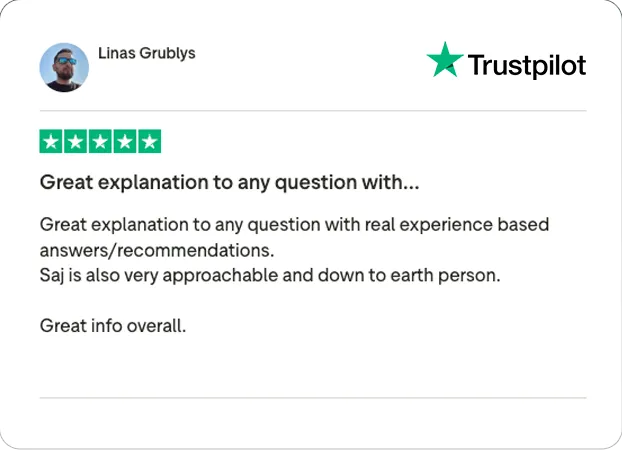
What Others Are Saying
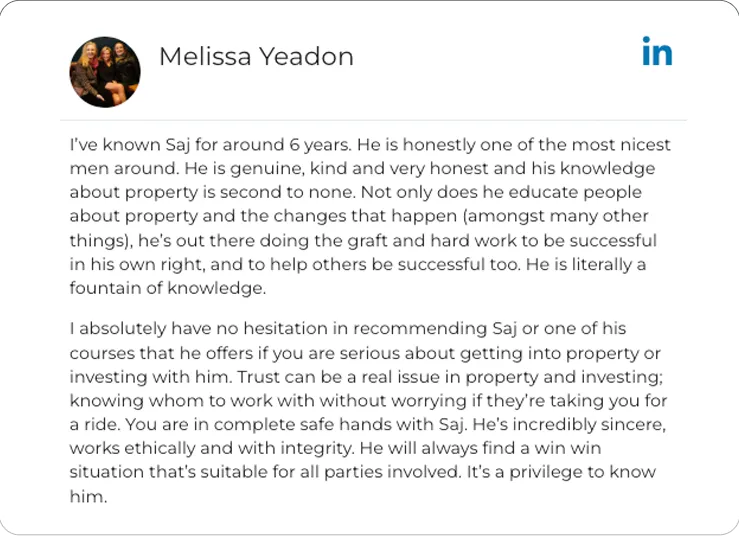

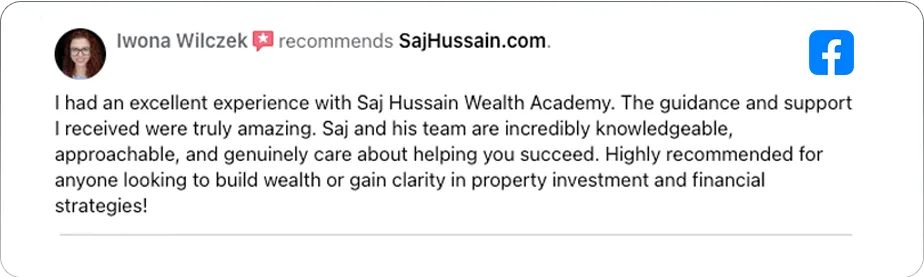



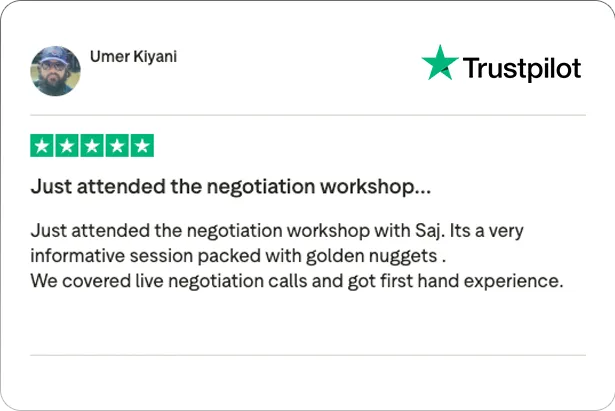







Meet the Operator Behind This Strategy
Saj Hussain
Over nearly two decades, Saj has built a multi-million pound property portfolio using none of his own money, working across everything from high-end HMOs to commercial conversions to supported accommodation.
He's co-founded seven property-related businesses, built a team of 31 staff, and his YouTube content has helped over 4 million viewers rethink what's possible in property investing.
But what's relevant for this training specifically is that Saj has been working inside the supported exempt accommodation space since 2020.

He understands the funding model, the profit structure, and the regulatory changes that are coming.
More importantly, he knows how to explain complex property strategies in a way that makes them accessible to intermediate investors who want to move quickly without cutting corners.
This session is about showing you what he and Henna have learned working inside this system - and why the window for entry is tightening faster than most investors realise.
The Workshop Details
29th August, 2026
9:00 a.m. to 5:30 p.m.
499
The ticket includes:
Full-day intensive training
Access to the council funding framework breakdown
Networking with vetted, serious investors
Direct Q&A
Refreshments & Lunch
Copyrights 2026 | Impact Network | Terms & Conditions